
GONIO PROBE
Clinical Interface & Usability System
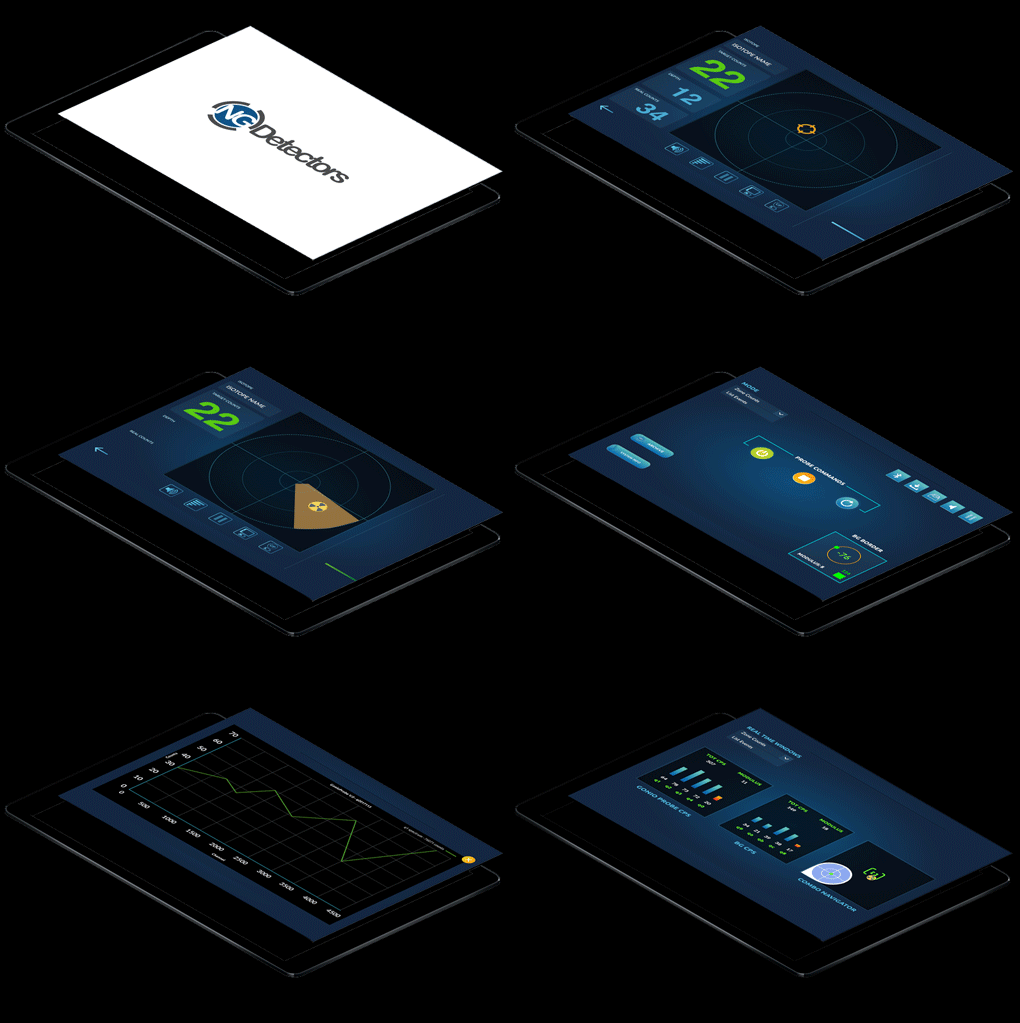
SCINTIGRAPHIC DESIGN
Designing for precision
SCINTIGRAPHIC DESIGN
Designing for precision
Designing the interface of a scintigraphic device means designing for precision, speed, and zero margin for error.
Born from a collaboration with Zero Division, a studio specialized in technological innovation, artificial intelligence, computer vision and blockchain, the project brought Elena Lazzara to work on Gonio Probe, a goniometric scintigraphic device for sentinel lymph node identification and the localization of specific lesions in oncological diagnosis, particularly in breast cancer.
As Digital Art Director and UI/UX Designer, she translated a complex diagnostic technology — developed by Prof. Roberto Pani together with NG Detectors‘ research (from the Department of Health Physics at Sapienza University of Rome) and engineering teams — into a clear, immediate and reliable interaction system, engineered to ensure operational precision, high legibility and dependable use in critical clinical environments.

GONIO PROBE INTERFACE
Usability under complex operating conditions
GONIO PROBE INTERFACE
Usability under complex operating conditions
The device’s interface is not used under standard conditions:
it is handled with surgical gloves, often in contexts of reduced visibility and concentration.
For this reason, the research phase focused on an apparently simple yet decisive aspect:
how and where to position the touch buttons, and at what size, so that they remain usable even through a glove.
Elena Lazzara conducted dedicated usability tests to define touch areas, spacing and minimum target sizes for interactive elements, redesigning the entire user interface and button system for fast, safe and unambiguous use.
REDUCING INTERVENTION TIME
Color, legibility
and patient comfort
In parallel, specific research was carried out on the device’s color palette, conceived for the clinical environment:
colors selected to ensure maximum legibility and to contribute to an experience that is as non-invasive as possible for the patient.
Every visual choice — from color contrast to the on-screen information hierarchy — was guided by the goal of speeding up the reading of scintigraphic data, reducing both intervention time and patient discomfort during the procedure.
REDUCING INTERVENTION TIME
Color, legibility and patient comfort
In parallel, specific research was carried out on the device’s color palette, conceived for the clinical environment:
colors selected to ensure maximum legibility and to contribute to an experience that is as non-invasive as possible for the patient.
Every visual choice — from color contrast to the on-screen information hierarchy — was guided by the goal of speeding up the reading of scintigraphic data, reducing both intervention time and patient discomfort during the procedure.
AN INVISIBLE DEVICE
From research to a UX/UI system
AN INVISIBLE DEVICE
From research to a UX/UI system
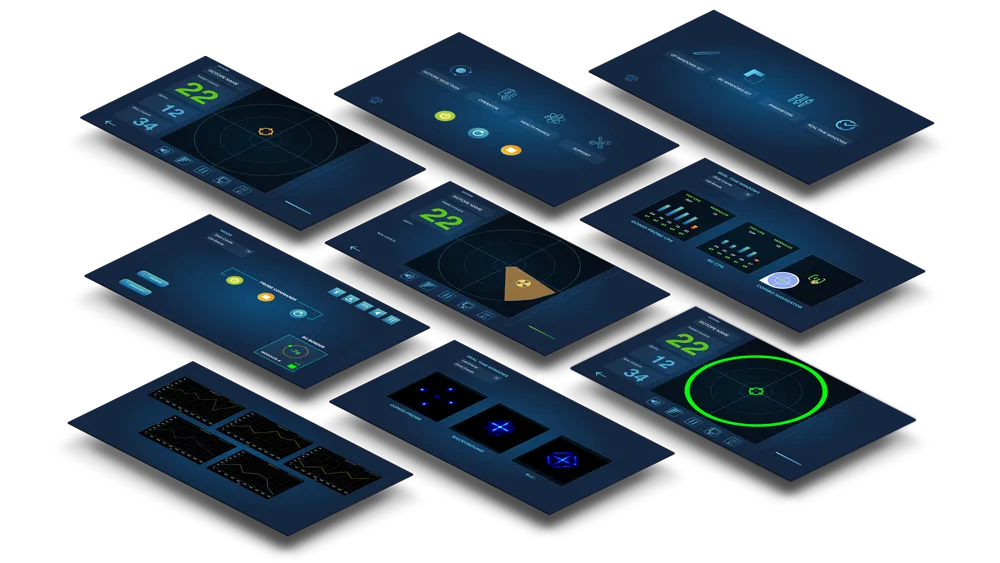
Elena Lazzara’s work covered the device’s entire user experience system: interface architecture, navigation flows, button system, and the visual hierarchy of information displayed in real time by the device’s control unit. The goal was not simply to make the device “usable,” but to make it invisible within the clinical gesture — a tool the operator can use naturally, without the interface becoming an additional cognitive burden in an already high-responsibility moment.

SPHERICAL METHOD IN ACTION
SPHERICAL METHOD
IN ACTION
In the Gonio Probe project, the Spherical Method was applied to govern the complexity of the entire clinical ecosystem, not just the interface.
The analysis connected the behavior of healthcare staff, the constraints of the environment where the device is used, the requirements of diagnostic technology, ergonomic principles, visual perception, and the decision-making processes that accompany every procedure.
From this systemic reading emerged an interaction language in which every element — from navigation flows to touch areas, down to information hierarchy — was designed to reduce the operator’s cognitive load, allowing the technology to integrate naturally into the clinical gesture.
This case demonstrates that the Spherical Method is not only suited to designing brands or digital experiences, but also high-criticality systems in which design directly influences precision, safety, and operational effectiveness.
PUBLIC RECOGNITION
Gonio Probe
on TGR Leonardo
The Gonio Probe project received national media attention:
the device was featured in a segment broadcast on TGR Leonardo, the scientific news program of Rai, Italy’s national public broadcaster, dedicated to science, environment, medicine and new technologies.

PUBLIC RECOGNITION
Gonio Probe on TGR Leonardo
The Gonio Probe project received national media attention:
the device was featured in a segment broadcast on TGR Leonardo, the scientific news program of Rai, Italy’s national public broadcaster, dedicated to science, environment, medicine and new technologies.